Orthodontics
Jomtien–Pattaya
A Smile and Bite Planned Around You
Beyond Straight Teeth
If crowded teeth make brushing difficult, or your upper and lower teeth do not meet comfortably when you chew, orthodontic treatment can move them into better positions.
Orthodontic treatment changes more than the appearance of your smile. It also adjusts how your upper and lower teeth meet, affecting chewing, cleaning and long-term tooth wear. At NEAR ME Dental Clinic, we plan treatment using X-rays and 3D oral scans. Before you decide, we explain how your teeth will move, the estimated treatment time and the full cost.
OUR SERVICES
Three Ways to Straighten Teeth
Orthodontics in One Place
Metal Braces
- Metal brackets are bonded to your teeth, with elastic bands holding the wire in place. Choose new band colors at each adjustment.
- The most affordable option, suitable for cases requiring substantial tooth movement.
- The braces are visible. Avoid hard or sticky foods and allow extra time for cleaning.
- Suitable for students and cases requiring significant tooth movement.
- Monthly visits · Approximately 26–32 months
Damon Braces
-
Brackets with built-in clips hold the wire in place.
No elastic bands needed. - Less friction between the wire and brackets allows continuous tooth movement. Visits are often spaced further apart, and there are no elastic bands to stain.
- Costs more than metal braces, and the brackets remain visible.
- Suitable for patients who cannot visit frequently or are concerned about staining around braces.
- Visits every 2 months · Approximately 12–24 months
Clear Aligners
- A series of removable clear trays, changed in sequence every week.
- Discreet when speaking and removable for meals and brushing.
- Wear for 20–22 hours a day. Results depend directly on consistent wear. This is the highest-cost option, and complex cases may also need fixed appliances.
- Suitable for working adults who meet clients and people who travel frequently.
- Visits every 2–4 months · Approximately 3–18 months
TECHNOLOGY & PLANNING
Assessing Your Teeth
Crowding, Gaps or Bite Problems
Your dentist will assess your teeth and create a personal treatment plan.
Treatment May Suit You If You Have
- Crowded or crooked teeth that are hard to brush
- Gaps between your teeth
- Protruding teeth or excessive overlap of the upper front teeth
- A deep bite, open bite or crossbite that makes chewing difficult
- Teeth that have tilted into a gap left by an old extraction
- Teeth that need repositioning before veneers, crowns or implants
- Teeth that have shifted after previous treatment without retainer wear
Address These Issues First
- Untreated tooth decay, gum inflammation or tartar
- Periodontal disease with bone loss around teeth, which needs stabilizing first
- Difficulty keeping teeth clean, as braces make cleaning more demanding
- Expectations of results within one or two months
TREATMENT JOURNEY
Care From Your First Visit to Retainers
01
Consultation & Examination
We check your teeth, gums and bite, and discuss your concerns and treatment expectations. Allow approximately 15–30 minutes.
02
X-rays, Photos & Scans
X-rays show the tooth roots and jawbone. We take photos of your teeth and use a digital scanner to record their shape, instead of conventional impression material.
03
Treatment Plan & Costs
Your dentist explains the proposed treatment, whether extractions or additional appliances are needed, the estimated timeline and detailed costs before you decide to start.
04
Oral Health Preparation
Scaling, fillings, extractions or wisdom tooth surgery are carried out as indicated in your treatment plan. These are charged separately from orthodontic treatment and may be eligible for Social Security benefits.
05
Fitting Braces or Aligners
For metal and Damon braces, your dentist bonds brackets and fits the wire. Fitting usually does not require local anesthesia. For clear aligners, tooth-colored attachments may be added to help control movement. We check the fit and show you how to insert, remove and clean your aligners.
06
Regular Review Visits
Fixed braces are usually adjusted every 4–8 weeks, with each visit taking around 15–30 minutes. Clear aligner visits may be further apart, and you may receive several sets to change in sequence at home. Your dentist sets the schedule according to your plan and progress.
07
Braces Removal & Retainers
Once your teeth and bite reach the planned positions, your dentist removes the braces or attachments and takes a scan or impression for retainers. We arrange collection and explain your wearing schedule.
pricing
Orthodontic Treatment Costs
Metal Braces
THB 36,000–48,000
Initial payment from THB 999 · Installments of THB 1,500
Damon Braces
THB 55,000–65,000
Initial payment from THB 15,000 · Installments of THB 2,500
Clear Aligners
THB 39,000–115,000
Initial payment from THB 5,000 · Installments of THB 20,000–30,000
Contact the clinic for full pricing details.
OUR DENTISTS
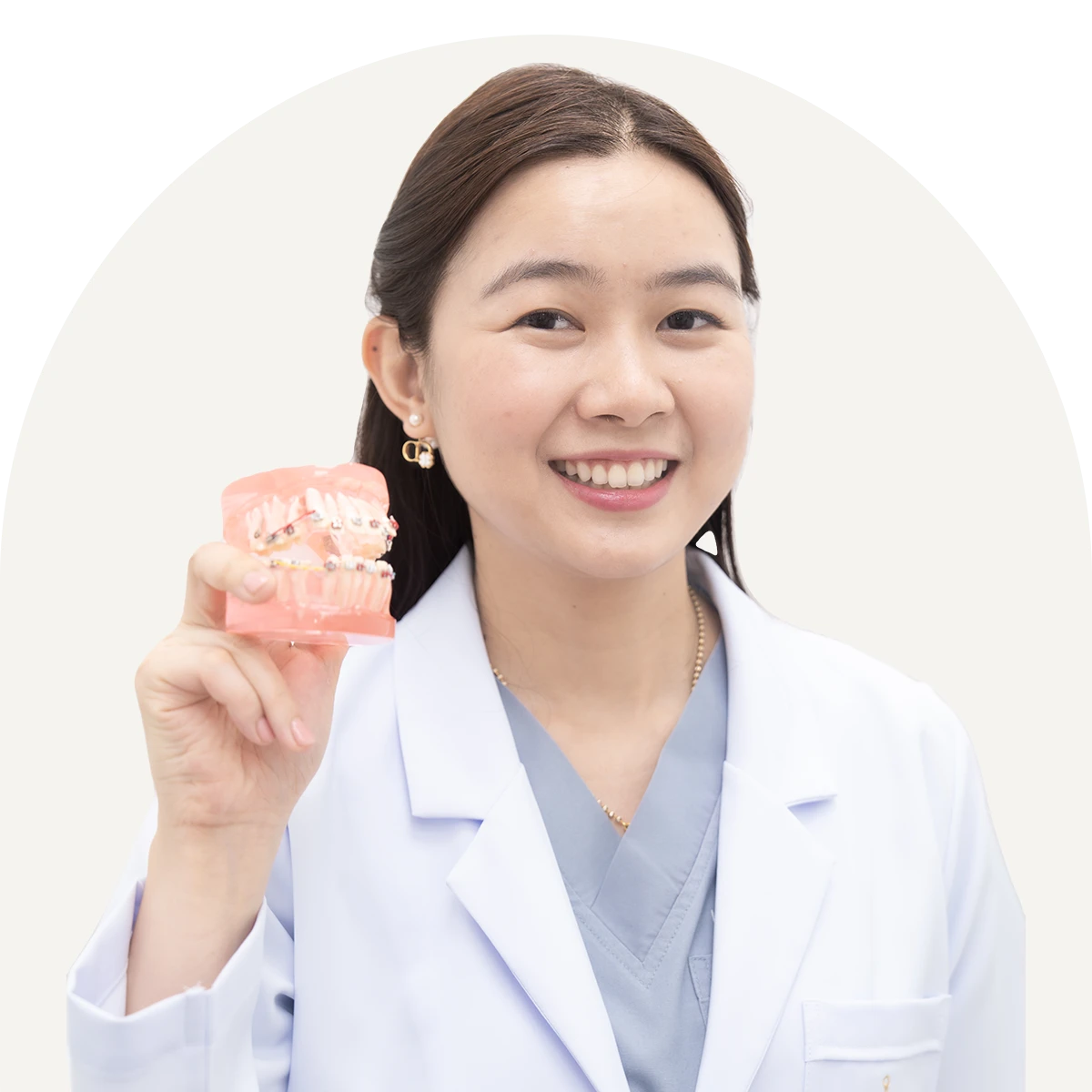
Your Treating Dentist
Dr. Pulaporn Kitkasetkul
Doctor of Dental Surgery, Thammasat University · Dental License No. 19249
Dental Implants, Oral Surgery, Crowns and Dentures
GOOD TO KNOW
Before You Start Treatment
Does It Hurt?
Fitting braces is generally painless and does not require local anesthesia, as the brackets are bonded to the tooth surfaces. After fitting or adjustments, your teeth may feel tight or tender when chewing. This is often most noticeable in the first two or three days and gradually improves. Choose soft foods during this time.
With clear aligners, your teeth may feel tight for the first day or two after switching to a new set. This usually eases gradually.
At first, the appliance may rub your cheeks or lips, causing irritation or sores. If you develop sores, severe pain, a poking wire or a loose appliance, call or message the clinic for advice without waiting for your next appointment.
Care During Treatment and After Braces
Keeping Your Teeth Clean
Brush with fluoride toothpaste after every meal. Use an interdental brush around brackets and under the wire, and floss with a floss threader at least once a day. Pay special attention to the areas around brackets, where food and plaque can easily collect.
Foods to Avoid With Fixed Braces
Avoid chewing ice, hard nuts, hard sweets, gum and sticky foods, which can loosen brackets or distort wires. Cut corn off the cob, slice apples and remove meat from the bone before eating, instead of biting directly with your front teeth.
Caring for Clear Aligners
Remove your aligners before eating or drinking anything except room-temperature plain water. Brush your teeth and clean the trays before putting them back in. Avoid hot water, which can distort them. Always store them in their case; wrapping them in tissue or leaving them on a table makes them easy to lose or discard.
Retainers: An Essential Final Step
Teeth can shift throughout life, especially in the first 6–12 months after braces are removed, while the surrounding bone is still adapting. Wearing retainers as instructed is part of treatment, not an optional extra.
Contact Us Before Your Next Visit If
A bracket comes loose, a wire pokes your cheek, a tooth becomes unusually loose, your gums remain swollen or bleed persistently, or your retainer feels unusually tight and will not fit.
Does Everyone Need Teeth Removed?
Fixed braces are usually adjusted every 4–8 weeks, with each visit taking around 15–30 minutes. Clear aligner visits may be further apart, and you may receive several sets to change in sequence at home. Your dentist sets the schedule according to your plan and progress.
How Long Does Treatment Take?
Timing depends on the complexity of your case and your treatment plan. Approximate durations are:
- Metal braces: 26–32 months
- Damon braces: 12–24 months
- Clear aligners: 3–18 months, or longer for complex cases
Your dentist will estimate the duration after an examination and treatment planning. These ranges do not mean one method is always faster than another. Attending appointments and wearing elastics or aligners as instructed help treatment stay on track.
Can I Have Treatment at 35–45?
Yes. Teeth can be moved at any age if the gums and supporting bone are healthy. Movement may be slower than in teenagers, and existing crowns or dentures often need to be considered in the treatment plan.
Will Orthodontics Slim My Face?
Orthodontic treatment changes the positions of teeth and lips, rather than the facial skeleton. Moving protruding teeth back can reduce lip prominence and change the side profile. If treatment only corrects crowding, the facial shape may change very little.
Can I Have Treatment While Living Abroad?
Clear aligners are often more practical than fixed braces in this situation because you can take several sets with you and do not need monthly adjustments. You still need reviews at intervals set by your dentist. Please share your travel schedule at the consultation so visits can be planned around your time in Thailand.